
Introducing Agentic Dispatch
Flight operations never lacked data. What they lacked was a way to connect it. Agentic Dispatch interprets everything that can change a flight and turns it into decisions, automatically.
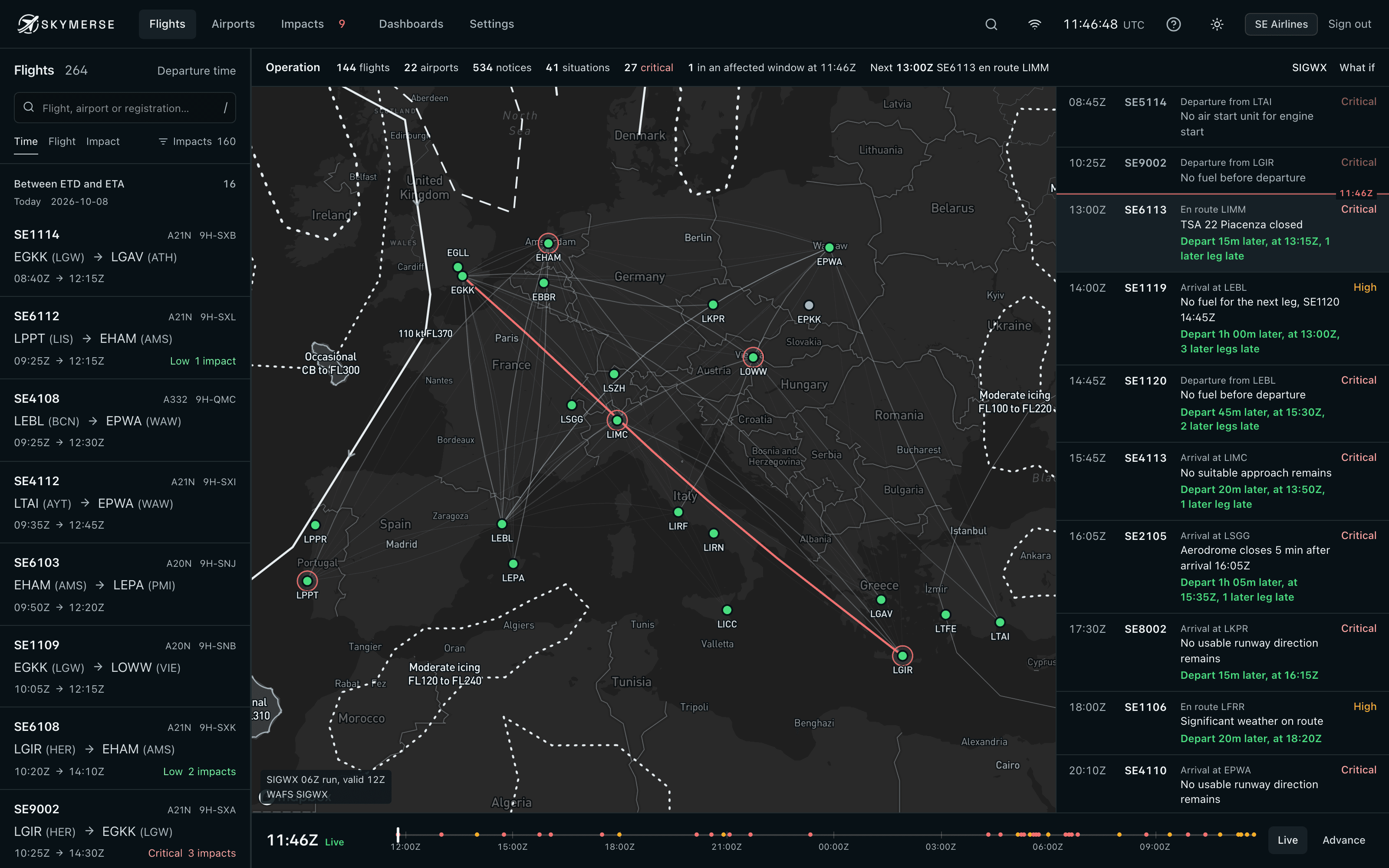
An operations centre is not short of information. Every night brings new notices, new forecasts, a new significant weather chart, AIP amendments, deferred defects, equipment outages and strike announcements. Every one of them can be read. The hard part is connecting them.
A runway closure means nothing on its own. It matters for an aircraft that needs that runway, in a wind that rules out the other one, at the hour it is scheduled to leave, on a rotation where every minute late carries into the next leg. Making that connection for every flight, every time something changes, is the real work of flight operations. Until now it has been done by hand.
Agentic Dispatch does it on its own, for every flight, around the clock. It interprets all of the data, connects it to each flight, and returns the decision, with the evidence behind it. It is not another screen of data. Your schedule goes in. Decisions come out.
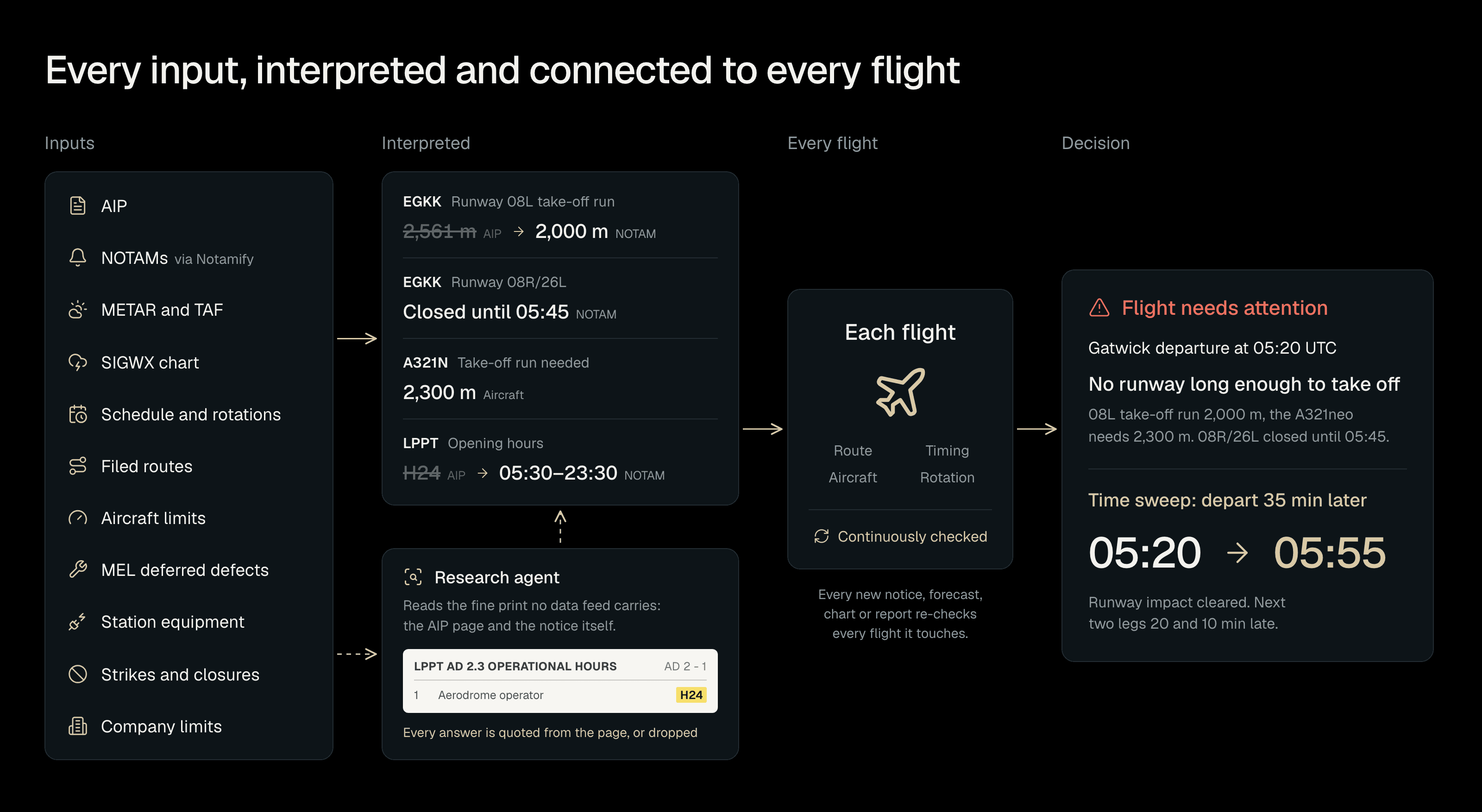
Five sources, one line
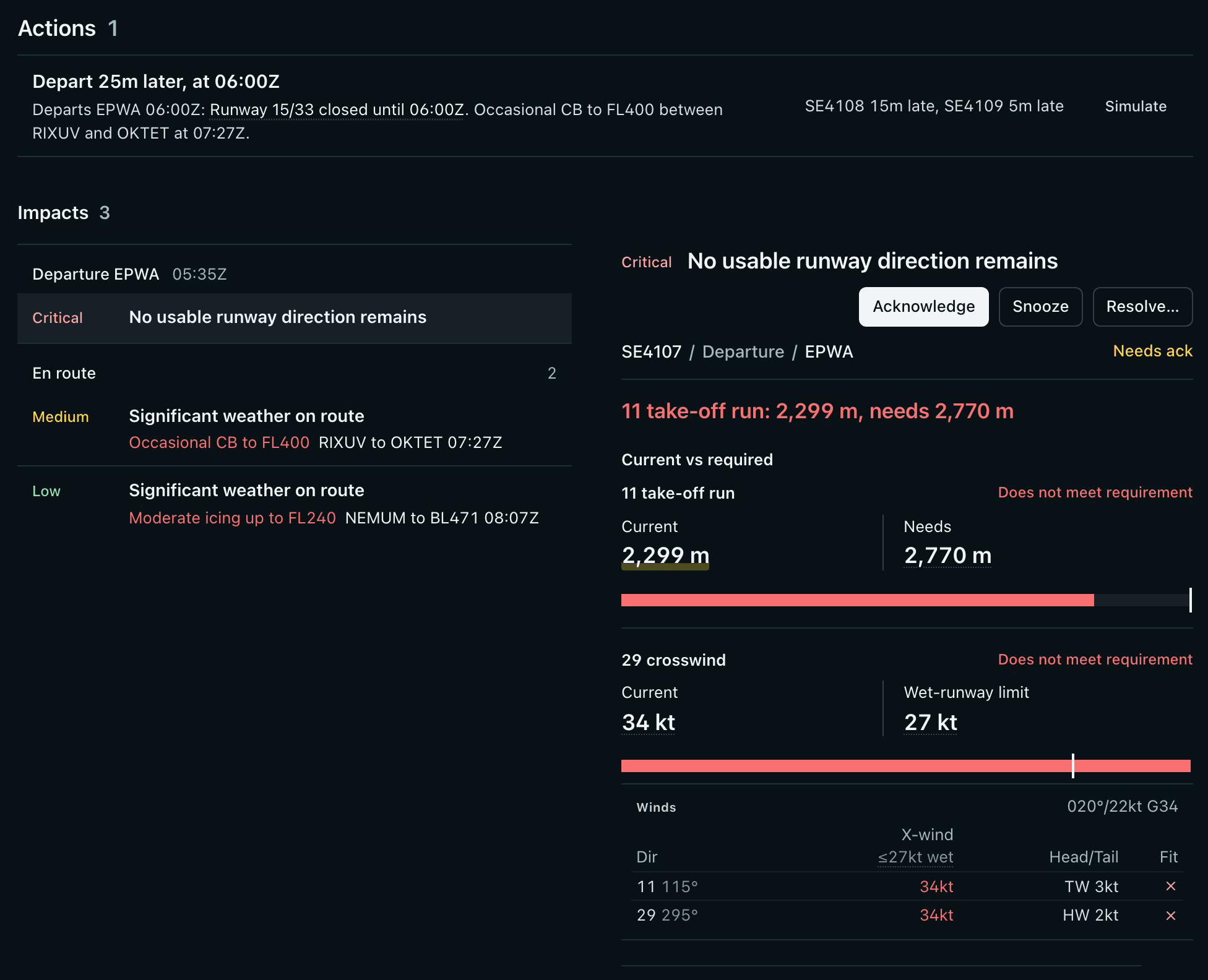
An Airbus A330-200 is scheduled out of Warsaw at 05:35 UTC. A notice closes runway 15/33 until 06:00. On the runway that remains, the aircraft needs 2,770 m to take off and has 2,299 m, and the crosswind reaches 34 kt against its 27 kt wet-runway limit. Further along the route, the significant weather chart forecasts occasional cumulonimbus to FL400.
No single source says this flight has a problem. Read together, they do, and they also say what to do about it: depart 25 minutes later, at 06:00 UTC, when the runway reopens. The aircraft's next two legs run 15 and 5 minutes late. Nobody had to look for it: Agentic Dispatch found the conflict, worked out the move and what it costs the aircraft's day, on its own, as soon as the notice was published.
The AIP, as amended tonight
Every airport is described twice. The AIP publishes what it is: its hours, its runways and their declared distances, its fire cover, its rules. NOTAMs publish what has changed since. Neither is the answer on its own. The answer is the AIP as amended by every notice in force at the moment the flight is there.
That is how Skymerse holds every airport: as an Interpreted AIP. The AIP becomes data the checks can compare, not pages to search. Each notice amends a specific element of it, and every value knows where it came from and what it replaced.
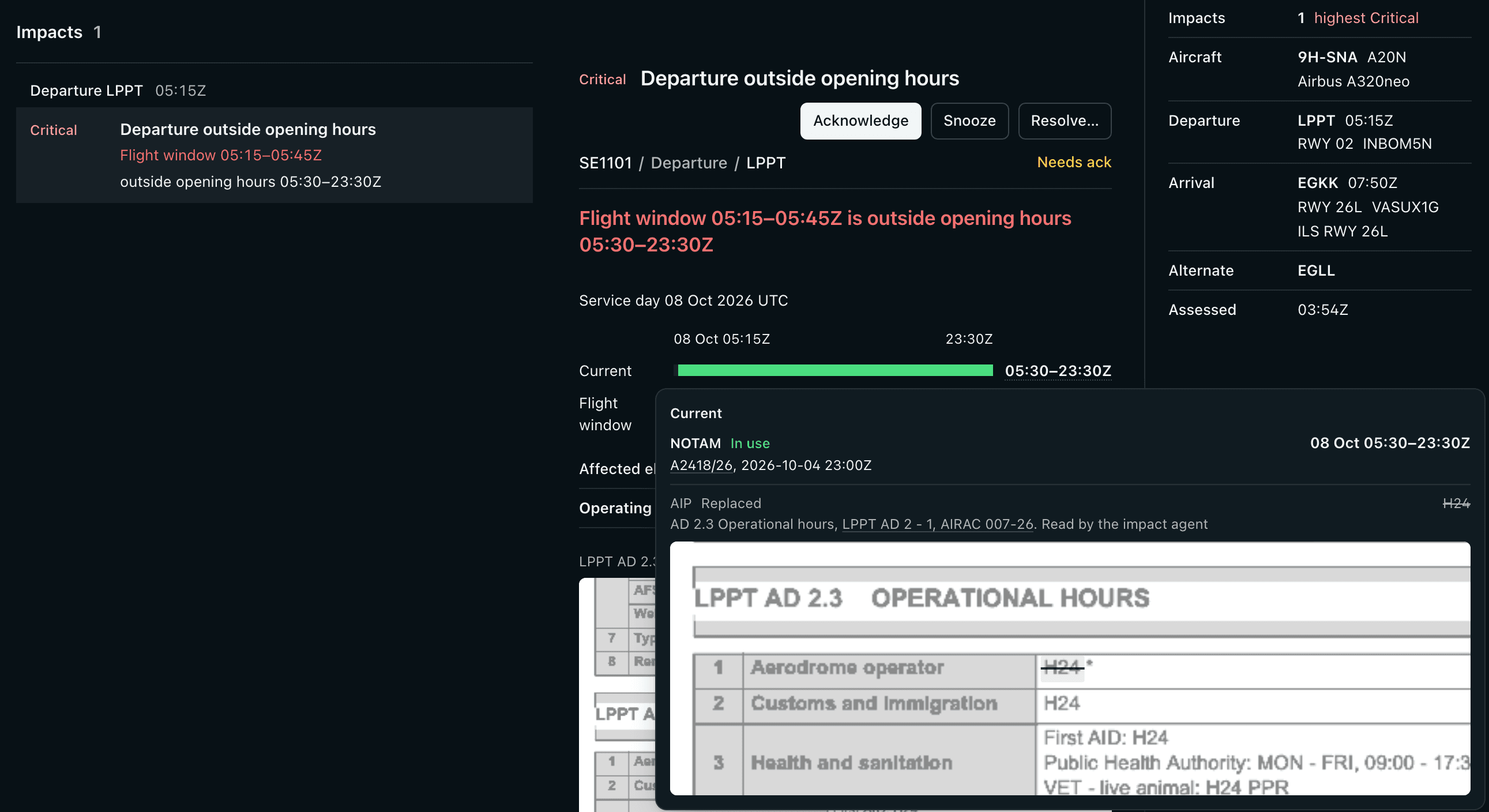
Lisbon's AIP lists the aerodrome as open H24. A notice limits it to 05:30–23:30 UTC. The notice names no flight, and the AIP is not wrong; together they mean that a departure scheduled for 05:15 is now outside the opening hours. At Gatwick, the AIP declares 2,561 m of take-off run on runway 08L. A notice cuts it to 2,000 m, and the A321neo needs 2,300 m. Each value shows both sources: the notice in use, and the AIP value it replaced.
We interpret the AIP of every airport the operation uses into typed values: runways and declared distances, fire cover, fuel, procedures. For the fine print, Skymerse Agents go back to the printed page itself: the opening hours in a table, the row behind a runway's declared distances, a noise rule or a local regulation written as a paragraph. Lisbon's H24 was read this way, and kept because it is printed exactly where the agent says it is. The same agents settle notices whose effect turns on a stand, a procedure or a page of the AIP. Every answer is quoted from the page, or dropped.
Time sweep: every departure, checked
When a flight is affected, the next question is when it would not be. Time sweep runs every check for the flight again at other departure times across the range the airline allows, and narrows each change down to five minutes. It is not an estimate. It is the same checks, with the forecast read at the moved time, the airspace at the moved crossing times, and the aircraft's later legs at their new times.
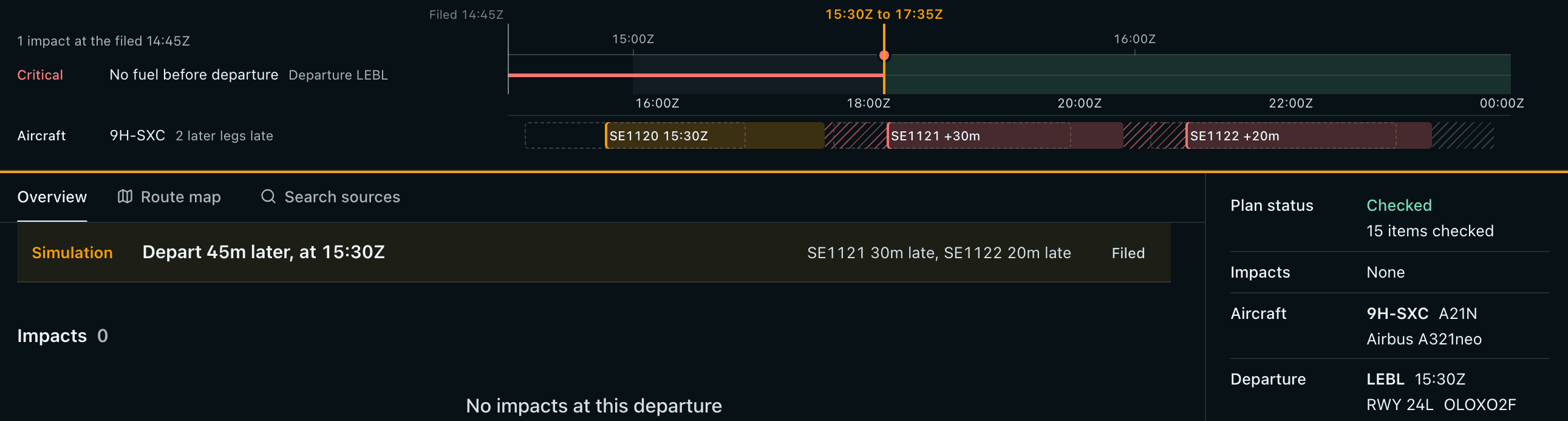
Barcelona has no fuel for this flight until 15:30 UTC. Departing at 15:30 leaves no impacts at all, and the aircraft's next two legs run 30 and 20 minutes late. The whole flight is checked again at the new time, and nothing remains.
Everything that can change a flight
The same interpretation runs across every input an operation depends on, not only NOTAMs:
- The AIP: opening hours, declared distances, fire cover, noise rules and local regulations.
- Notices, interpreted by Notamify into the exact elements of the AIP they amend.
- METAR and TAF, at the time the flight is there.
- The significant weather chart, along the planned route at the planned levels and times.
- The aircraft: take-off and landing distances, crosswind limits, fire cover, fuel and its noise certificate.
- Deferred defects, held against the ground equipment at each station.
- Strikes and closures announced outside the NOTAM system.
- The airline's own airport limits, and every aircraft's rotation.
Each input is connected to every flight it touches, at the moment that flight is there, and assessed again the moment it changes. Whatever does not change a flight is set aside with its reason, so what remains is worth acting on.
Every airport, one answer
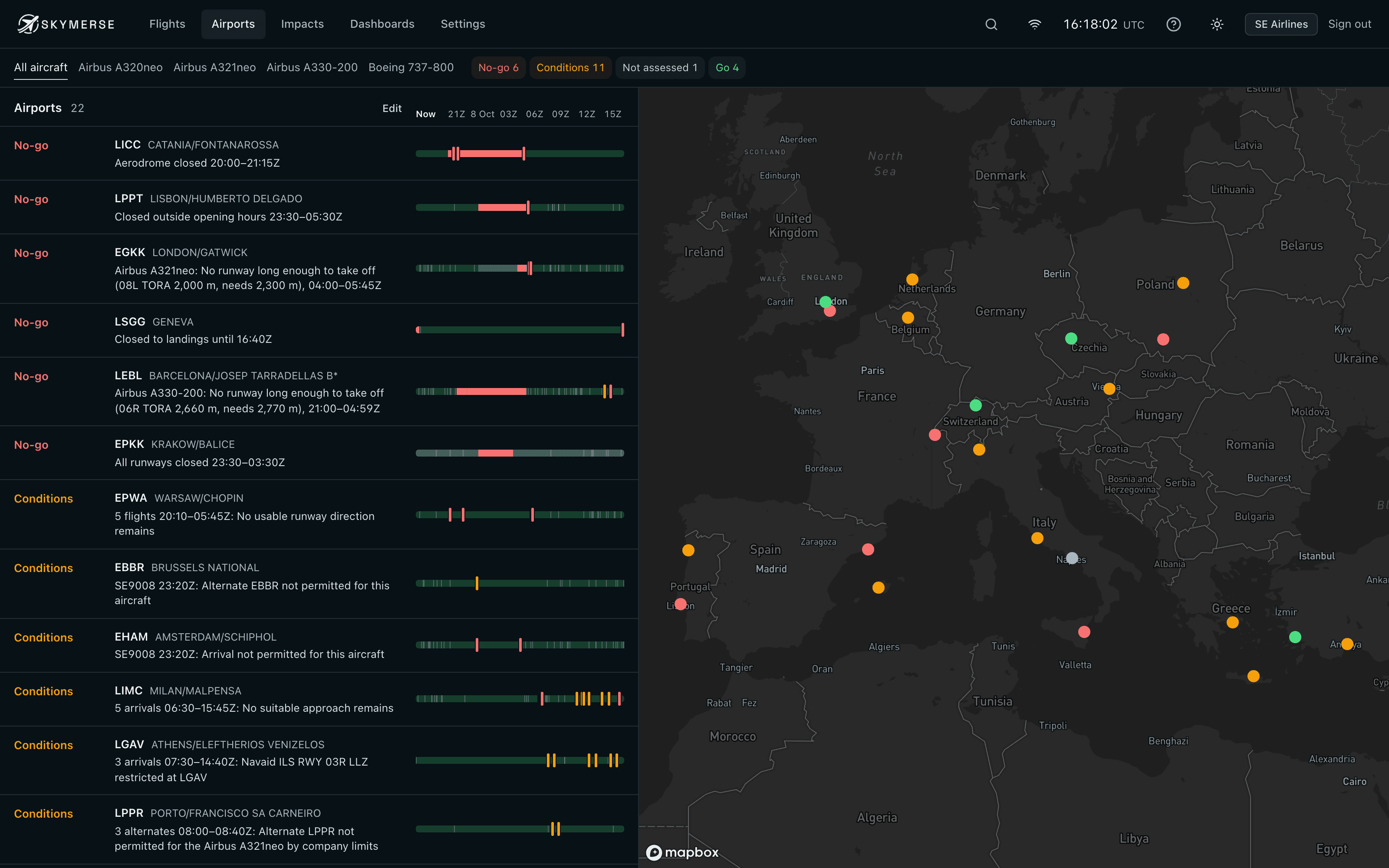
The same connections answer for the whole network. Gatwick has no runway long enough for the A321neo to take off between 04:00 and 05:45. Porto is not an approved alternate for the A321neo under the company's own limits. Five arrivals into Malpensa have no suitable approach. Each answer is one line, specific to the aircraft, with the hours it holds.
Why this is the unlock
Information was never the bottleneck. Decisions were. In Europe, 46% of departure delay minutes in 2024 were knock-on delay, passed down from an earlier flight, according to EUROCONTROL. A minute of aircraft block time cost US airlines $100.76 in 2024, according to Airlines for America. A conflict found at the gate becomes a delay that follows the aircraft all day. Found the evening before, it is a move of a few minutes.
- Decisions, not data. What took a chain of lookups across five systems is one line.
- Early. A conflict is found as soon as the schedule meets it, while the fix is still small.
- Every flight, every hour. The same standard at 03:00 as at 15:00, including at airports the team rarely flies to.
- Proven. Every number opens its source: the notice, the AIP page it amends, the forecast, the certificate.
- Automatic. Every new notice, forecast, chart or report re-checks every flight it touches, with no one asking.
We are building Agentic Dispatch with airlines and operators who make these decisions every day. If you run flight operations, we would like to show it to you.